×

Windsor Words
December 2025
PRINCIPAL'S NEWS
It is bewildering how quickly time moves; it only feels like a couple of months ago that I was writing articles in Term 1. The final newsletter article is always an interesting one to write. It is with excitement, happiness, sadness and reflection that I connect with this time of year.
While it is with sadness that we will say farewell to our Year 6 students and other students moving to other areas of Melbourne, Victoria, Australia and the world, it is with excitement that we have had our 2026 Prep students participate in their Off to School program. Spending time with our new parents over the four weeks, I have seen them move from completely uncertain about school commencement to having a developed understanding. Welcome to our wonderful school and community. Thank you to Catherine, Kath, Mary and Michelle for all the work put into this program and for Lucy, Bella and Steve also contributing to the parent presentations.
The law prohibits individuals under 16 years old from having social-media accounts on a list of major platforms (including Facebook, Instagram, TikTok, Snapchat, YouTube, X (Twitter), Reddit, Twitch and others. Social-media companies must take what the law calls “reasonable steps” to remove or block under-16 accounts. If they fail to comply, they may face fines — up to AUD 49.5 million.
Importantly, the intent of law targets the platforms, not the children or their families. There are no legal penalties for under-16s or parents for having an account. According to the government, the aim is to better protect children from online harms associated with social media — including risks such as cyberbullying, exposure to inappropriate content, and negative mental-health impacts.
Supporters see it as a form of digital safety comparable to regulations around alcohol, seatbelts or other age-based laws — a safeguard to give children a chance to grow without some of the pressures of social media.
Students under 16 will likely lose access to many common social media platforms. Families may consider how children connect with peers, particularly outside school. There may be a period of adjustment — social media has been a major part of how young people socialise, share, and stay connected. As a school, we view this as an opportunity to encourage face-to-face connection, offline hobbies, and safe, supportive peer and family interactions during this transition.
We also recognise that some families may have questions or concerns about what the change means. We encourage open conversations at home about online safety, identity, and respectful digital behaviour. Use this change as a chance to explore offline interests — sports, creative pursuits, reading, hobbies, and in-person time with friends and family.
Encourage open discussions with your children about how they feel about the change: some may feel relieved; others may worry about missing out. Stay alert to alternative platforms or attempts to bypass the rules (for example via VPNs) — and talk openly about the risks and reasons behind the law.
We know this is a major shift for many families. As a school, we’re committed to supporting our students and helping parents navigate this change. If you have any questions or concerns, please feel free to reach out to us.
Below is a link to the Australian government e-safety commissioner frequently asked questions about the new law.
https://www.esafety.gov.au/about-us/industry-regulation/social-media-age-restrictions/faqs
Our staffing will have some changes in 2026, our Assistant Principal, Simone Radolnik will be taking a year’s leave. Simone’s 2026 will be full of travel, family and relaxation - maybe something that will be too irresistible to return from; we wish Simone all the best for her ‘discovery’ year. Stepping up into the Wellbeing leadership role will be Stephen McLeod. While Steve will still fulfil his Science program commitments, he will step away from his Teaching and Learning leadership position.
Taking on this responsibility will be Kathrine Gratz. Rounding out the 2026 leadership team is Ben Eretz who will be taking on the newly established Department of Education position of Mental Health in Primary Schools leader. This position is part time and will focus on attendance, the personal and social development curriculum and our ready to learn routines.
We are sad to announce that our long time staff member, Nathan Heaton, has decided to head home to family in the Geelong area next year. While still young in regard to age and teaching, Nathan has been at Windsor since 2012, when he took up a student placement position with Sam Fitzgerald. Nathan soon took on a Classroom Education Support position with the school before taking leave to complete his teaching degree. It has been terrific to have had Nathan being part of Windsor for so long and for us to have been such a big part of his professional journey. We wish the very best to Nathan personally and professionally and thank him for his wonderful contribution to our school and community.
We do welcome Kieran McIntyre into our full time teaching program. Kieran has been with the school as a casual relief teacher for most of 2025 and we look forward to having his skill set and experience with the senior primary years with us next year.
Both Jacqui May and Rosie Noone are continuing their parental family leave in 2026.
2026 Teaching Structure
Prep A - Catherine McGarrity
1/2A - Jenna Barker (Mon-Weds) and Mia Amon (Thurs-Fri)
3/4A - Amy Dorozenko (Mon-Weds) and Ben Eretz (Thurs-Fri)
5/6A - Tom Gosling
5/6B - Kieran McIntyre
Greek Art - Connie Barkatsas
Music - Paul Cartright
Physical Education - Mia Amon
Science - Stephen McLeod
Finally, a huge thank you to everyone who has contributed to making Windsor Primary School such a wonderful place to be part of. Our staff and our parent contributors most definitely an amazing group of people. Things are not easy at Windsor due to our budget constraints, however every minute thing that our contributors give us, whether it is the staff with their abundance of professional expertise and personal compassion and regard, or it is our parent community giving their time, effort or financial support helps provide our students with the education expertise and programs that every student deserves.
Our staff resume on Tuesday, January 27 and then our students (all year levels) resume on Thursday, January 29.
On behalf of Simone, myself and the entire WPS team, I wish everyone a happy and safe summer break.
While it is with sadness that we will say farewell to our Year 6 students and other students moving to other areas of Melbourne, Victoria, Australia and the world, it is with excitement that we have had our 2026 Prep students participate in their Off to School program. Spending time with our new parents over the four weeks, I have seen them move from completely uncertain about school commencement to having a developed understanding. Welcome to our wonderful school and community. Thank you to Catherine, Kath, Mary and Michelle for all the work put into this program and for Lucy, Bella and Steve also contributing to the parent presentations.
Social Media Age Restrictions
You may be aware that, as of 10 December 2025, a new national law took effect in Australia that has major implications for children’s use of social media, in particular our students in the senior grades.The law prohibits individuals under 16 years old from having social-media accounts on a list of major platforms (including Facebook, Instagram, TikTok, Snapchat, YouTube, X (Twitter), Reddit, Twitch and others. Social-media companies must take what the law calls “reasonable steps” to remove or block under-16 accounts. If they fail to comply, they may face fines — up to AUD 49.5 million.
Importantly, the intent of law targets the platforms, not the children or their families. There are no legal penalties for under-16s or parents for having an account. According to the government, the aim is to better protect children from online harms associated with social media — including risks such as cyberbullying, exposure to inappropriate content, and negative mental-health impacts.
Supporters see it as a form of digital safety comparable to regulations around alcohol, seatbelts or other age-based laws — a safeguard to give children a chance to grow without some of the pressures of social media.
Students under 16 will likely lose access to many common social media platforms. Families may consider how children connect with peers, particularly outside school. There may be a period of adjustment — social media has been a major part of how young people socialise, share, and stay connected. As a school, we view this as an opportunity to encourage face-to-face connection, offline hobbies, and safe, supportive peer and family interactions during this transition.
We also recognise that some families may have questions or concerns about what the change means. We encourage open conversations at home about online safety, identity, and respectful digital behaviour. Use this change as a chance to explore offline interests — sports, creative pursuits, reading, hobbies, and in-person time with friends and family.
Encourage open discussions with your children about how they feel about the change: some may feel relieved; others may worry about missing out. Stay alert to alternative platforms or attempts to bypass the rules (for example via VPNs) — and talk openly about the risks and reasons behind the law.
We know this is a major shift for many families. As a school, we’re committed to supporting our students and helping parents navigate this change. If you have any questions or concerns, please feel free to reach out to us.
Below is a link to the Australian government e-safety commissioner frequently asked questions about the new law.
https://www.esafety.gov.au/about-us/industry-regulation/social-media-age-restrictions/faqs
Transitioning to 2026
Last Tuesday was a big day in our 2026 transition program - everyone finds out about the 2026 classes and teaching structures. At 9.30am this morning students participated in a step up program in their 2026 classes with their 2026 teacher/s.Our staffing will have some changes in 2026, our Assistant Principal, Simone Radolnik will be taking a year’s leave. Simone’s 2026 will be full of travel, family and relaxation - maybe something that will be too irresistible to return from; we wish Simone all the best for her ‘discovery’ year. Stepping up into the Wellbeing leadership role will be Stephen McLeod. While Steve will still fulfil his Science program commitments, he will step away from his Teaching and Learning leadership position.
Taking on this responsibility will be Kathrine Gratz. Rounding out the 2026 leadership team is Ben Eretz who will be taking on the newly established Department of Education position of Mental Health in Primary Schools leader. This position is part time and will focus on attendance, the personal and social development curriculum and our ready to learn routines.
We are sad to announce that our long time staff member, Nathan Heaton, has decided to head home to family in the Geelong area next year. While still young in regard to age and teaching, Nathan has been at Windsor since 2012, when he took up a student placement position with Sam Fitzgerald. Nathan soon took on a Classroom Education Support position with the school before taking leave to complete his teaching degree. It has been terrific to have had Nathan being part of Windsor for so long and for us to have been such a big part of his professional journey. We wish the very best to Nathan personally and professionally and thank him for his wonderful contribution to our school and community.
We do welcome Kieran McIntyre into our full time teaching program. Kieran has been with the school as a casual relief teacher for most of 2025 and we look forward to having his skill set and experience with the senior primary years with us next year.
Both Jacqui May and Rosie Noone are continuing their parental family leave in 2026.
2026 Teaching Structure
Prep A - Catherine McGarrity
1/2A - Jenna Barker (Mon-Weds) and Mia Amon (Thurs-Fri)
3/4A - Amy Dorozenko (Mon-Weds) and Ben Eretz (Thurs-Fri)
5/6A - Tom Gosling
5/6B - Kieran McIntyre
Greek Art - Connie Barkatsas
Music - Paul Cartright
Physical Education - Mia Amon
Science - Stephen McLeod
Finally, a huge thank you to everyone who has contributed to making Windsor Primary School such a wonderful place to be part of. Our staff and our parent contributors most definitely an amazing group of people. Things are not easy at Windsor due to our budget constraints, however every minute thing that our contributors give us, whether it is the staff with their abundance of professional expertise and personal compassion and regard, or it is our parent community giving their time, effort or financial support helps provide our students with the education expertise and programs that every student deserves.
Our staff resume on Tuesday, January 27 and then our students (all year levels) resume on Thursday, January 29.
On behalf of Simone, myself and the entire WPS team, I wish everyone a happy and safe summer break.
CALENDAR DATES
Important Dates
Whilst teenagers can think more abstractly than younger children, their brains are still developing, particularly the prefrontal cortex responsible for emotional regulation and long-term planning. This means they can understand complex global issues but may struggle to put them in perspective or manage the anxiety these issues provoke.
Research shows that teenagers who set unrealistic goals about changing the world are less happy than those who focus on achievable contributions. This is particularly relevant when discussing climate change and global issues with your teenager.
Four strategic approaches
Encourage Meaningful but Realistic Action Rather than trying to solve climate change single-handedly, help your teenager identify specific, manageable ways to contribute. This might involve joining environmental groups at school, volunteering with local organisations, or researching careers that align with their values. The key is helping them understand that meaningful change happens through sustained, collective effort rather than grand gestures.
When teenagers feel they can contribute meaningfully to solutions, it builds what I call a 'growth mindset' - the belief that challenges are opportunities for growth rather than insurmountable obstacles². This approach helps them develop resilience thinking skills that will serve them throughout their lives.
Discuss Media Consumption Critically Teenagers are sophisticated consumers of information, but they need guidance in developing media literacy. Discuss how news outlets and social media platforms are designed to capture attention through dramatic presentation. Help them identify reliable sources and encourage them to limit their consumption of distressing content.
Unlike with younger children, complete avoidance isn't realistic or appropriate for teenagers. Instead, help them develop skills to critically evaluate information and manage their emotional responses to it. This includes understanding how the constant stream of negative news can create a distorted view of reality.
Facilitate Deep Conversations Teenagers need space to express their concerns about world events without judgment. Create opportunities for meaningful discussions about their fears and frustrations. Listen actively to their perspectives and validate their emotions whilst helping them think through realistic responses.
Use these conversations to explore complex topics like the balance between individual responsibility and systemic change, the role of technology in both creating and solving problems, and how to maintain hope whilst acknowledging serious challenges. These discussions help teenagers develop sophisticated thinking skills and emotional regulation strategies.
Model Proportional Response Show your teenager how to respond proportionally to global challenges. This means taking appropriate action without becoming consumed by anxiety about things beyond individual control. Demonstrate how to stay informed without becoming
overwhelmed, how to contribute meaningfully without taking on unrealistic responsibility, and how to maintain hope whilst acknowledging difficulties.
Supporting Emotional Regulation
Teenagers are particularly susceptible to anxiety about global issues because they're developing their sense of identity and place in the world. Help them understand that feeling concerned about climate change and global injustices reflects their developing moral reasoning and empathy - these are positive qualities that, when channelled appropriately, can lead to meaningful contributions.
However, it's important to help them distinguish between productive concern that motivates action and overwhelming anxiety that leads to paralysis. Teach them techniques for managing intense emotions, such as mindfulness practices, physical exercise, and maintaining connections with friends and family.
Building Future-Focused Resilience
The goal with teenagers is to help them develop what I call 'active hope' - the ability to maintain optimism whilst taking concrete steps towards positive change. This involves helping them understand that whilst global challenges are real and serious, human ingenuity, cooperation, and sustained effort have solved significant problems throughout history.
Encourage your teenager to think about their long-term goals and how they might contribute to solutions in their future careers or civic engagement. This forward-thinking approach helps them see themselves as part of the solution rather than helpless victims of global problems.
Discussing world events with teenagers requires balancing honest acknowledgement of challenges with realistic hope for positive change. By helping your teenager develop critical thinking skills, emotional regulation strategies, and a sense of agency, you're preparing them to be thoughtful, resilient citizens who can contribute meaningfully to addressing global challenges.
Remember, the goal isn't to eliminate your teenager's concern about world events - their awareness and care are signs of healthy moral development. Instead, we want to help them channel these concerns into productive action whilst maintaining their mental health and optimism about the future.
¹ Harvard Center on the Developing Child, "The Science of Resilience" (2015)
² Dweck, C., "Mindset: The New Psychology of Success" (2006)
Michael Hawton is founder of Parentshop, providing education and resources for parents and industry professionals working with children. He has authored two books on child behaviour management: Talk Less Listen More and Engaging Adolescents. You can find more information, including his books and self-paced online parenting courses at https://www.parentshop.com.au/parent-courses/
Bookings can be made via the QR code

or the following website: https://www.trybooking.com/CNWMT
To book your child/ren visit www.commosh.edu.au
School uniform order forms need to be completed with payment and returned to the office either by your child or via e-mail at windsor.ps@education.vic.gov.au
School Uniform Order Form
Please remember all orders must be placed online before 9:00am at beaverstail.com.au
Lunch Order Menu
.png)
.png)
- Melbourne Cup
Date: November 03, 2026
Time: All Day
- Whole School Swimming Program @ St Mary's College - Swimable
Date: November 10, 2026
Time: 11:30am - 03:30pm
- Off To School - Session 1
Date: November 12, 2026
Time: 09:15am - 10:00am
- Whole School Swimming Program
Date: November 17, 2026
Time: 11:30am - 03:30pm
- Off To School - Session 2
Date: November 19, 2026
Time: 09:15am - 10:00am
- Off To School - Session 3
Date: November 26, 2026
Time: 09:15am - 10:00am
- Off To School - Session 4
Date: December 03, 2026
Time: 09:15am - 10:00am
- Yr 3-6 School Camp
Date: December 09, 2026
Time: All Day
- Last Day of Term 4 - Students dismissed @ 1:30pm
Date: December 18, 2026
Time: 09:00am - 01:30pm
WINDSOR INFORMATION
Helping Young Minds Navigate Big World Events: A Guide for Parents
By Michael Hawton, Child Psychologist (MAPS) and Parentshop founder.
Teenagers today are bombarded with information about climate change, global conflicts, and social injustices through social media and news platforms. Unlike younger children, adolescents have greater cognitive capacity to understand these issues, but they're also more likely to feel overwhelmed by their apparent magnitude and their perceived powerlessness to create change¹.Whilst teenagers can think more abstractly than younger children, their brains are still developing, particularly the prefrontal cortex responsible for emotional regulation and long-term planning. This means they can understand complex global issues but may struggle to put them in perspective or manage the anxiety these issues provoke.
Research shows that teenagers who set unrealistic goals about changing the world are less happy than those who focus on achievable contributions. This is particularly relevant when discussing climate change and global issues with your teenager.
Four strategic approaches
Encourage Meaningful but Realistic Action Rather than trying to solve climate change single-handedly, help your teenager identify specific, manageable ways to contribute. This might involve joining environmental groups at school, volunteering with local organisations, or researching careers that align with their values. The key is helping them understand that meaningful change happens through sustained, collective effort rather than grand gestures.
When teenagers feel they can contribute meaningfully to solutions, it builds what I call a 'growth mindset' - the belief that challenges are opportunities for growth rather than insurmountable obstacles². This approach helps them develop resilience thinking skills that will serve them throughout their lives.
Discuss Media Consumption Critically Teenagers are sophisticated consumers of information, but they need guidance in developing media literacy. Discuss how news outlets and social media platforms are designed to capture attention through dramatic presentation. Help them identify reliable sources and encourage them to limit their consumption of distressing content.
Unlike with younger children, complete avoidance isn't realistic or appropriate for teenagers. Instead, help them develop skills to critically evaluate information and manage their emotional responses to it. This includes understanding how the constant stream of negative news can create a distorted view of reality.
Facilitate Deep Conversations Teenagers need space to express their concerns about world events without judgment. Create opportunities for meaningful discussions about their fears and frustrations. Listen actively to their perspectives and validate their emotions whilst helping them think through realistic responses.
Use these conversations to explore complex topics like the balance between individual responsibility and systemic change, the role of technology in both creating and solving problems, and how to maintain hope whilst acknowledging serious challenges. These discussions help teenagers develop sophisticated thinking skills and emotional regulation strategies.
Model Proportional Response Show your teenager how to respond proportionally to global challenges. This means taking appropriate action without becoming consumed by anxiety about things beyond individual control. Demonstrate how to stay informed without becoming
overwhelmed, how to contribute meaningfully without taking on unrealistic responsibility, and how to maintain hope whilst acknowledging difficulties.
Supporting Emotional Regulation
Teenagers are particularly susceptible to anxiety about global issues because they're developing their sense of identity and place in the world. Help them understand that feeling concerned about climate change and global injustices reflects their developing moral reasoning and empathy - these are positive qualities that, when channelled appropriately, can lead to meaningful contributions.
However, it's important to help them distinguish between productive concern that motivates action and overwhelming anxiety that leads to paralysis. Teach them techniques for managing intense emotions, such as mindfulness practices, physical exercise, and maintaining connections with friends and family.
Building Future-Focused Resilience
The goal with teenagers is to help them develop what I call 'active hope' - the ability to maintain optimism whilst taking concrete steps towards positive change. This involves helping them understand that whilst global challenges are real and serious, human ingenuity, cooperation, and sustained effort have solved significant problems throughout history.
Encourage your teenager to think about their long-term goals and how they might contribute to solutions in their future careers or civic engagement. This forward-thinking approach helps them see themselves as part of the solution rather than helpless victims of global problems.
Discussing world events with teenagers requires balancing honest acknowledgement of challenges with realistic hope for positive change. By helping your teenager develop critical thinking skills, emotional regulation strategies, and a sense of agency, you're preparing them to be thoughtful, resilient citizens who can contribute meaningfully to addressing global challenges.
Remember, the goal isn't to eliminate your teenager's concern about world events - their awareness and care are signs of healthy moral development. Instead, we want to help them channel these concerns into productive action whilst maintaining their mental health and optimism about the future.
¹ Harvard Center on the Developing Child, "The Science of Resilience" (2015)
² Dweck, C., "Mindset: The New Psychology of Success" (2006)
Michael Hawton is founder of Parentshop, providing education and resources for parents and industry professionals working with children. He has authored two books on child behaviour management: Talk Less Listen More and Engaging Adolescents. You can find more information, including his books and self-paced online parenting courses at https://www.parentshop.com.au/parent-courses/
WPS Breakfast Activities Club
A reminder that staff supervision in the morning does not begin until 8:45am. Students arriving before 8:45am without parent supervision are required to be booked into the WPS Breakfast Activities Club, which runs from 7:30am - 8:45am everyday. Students must be pre-booked to attend. The cost is $10.75 per session per child and includes breakfast and activities.Bookings can be made via the QR code
or the following website: https://www.trybooking.com/CNWMT
After School Care
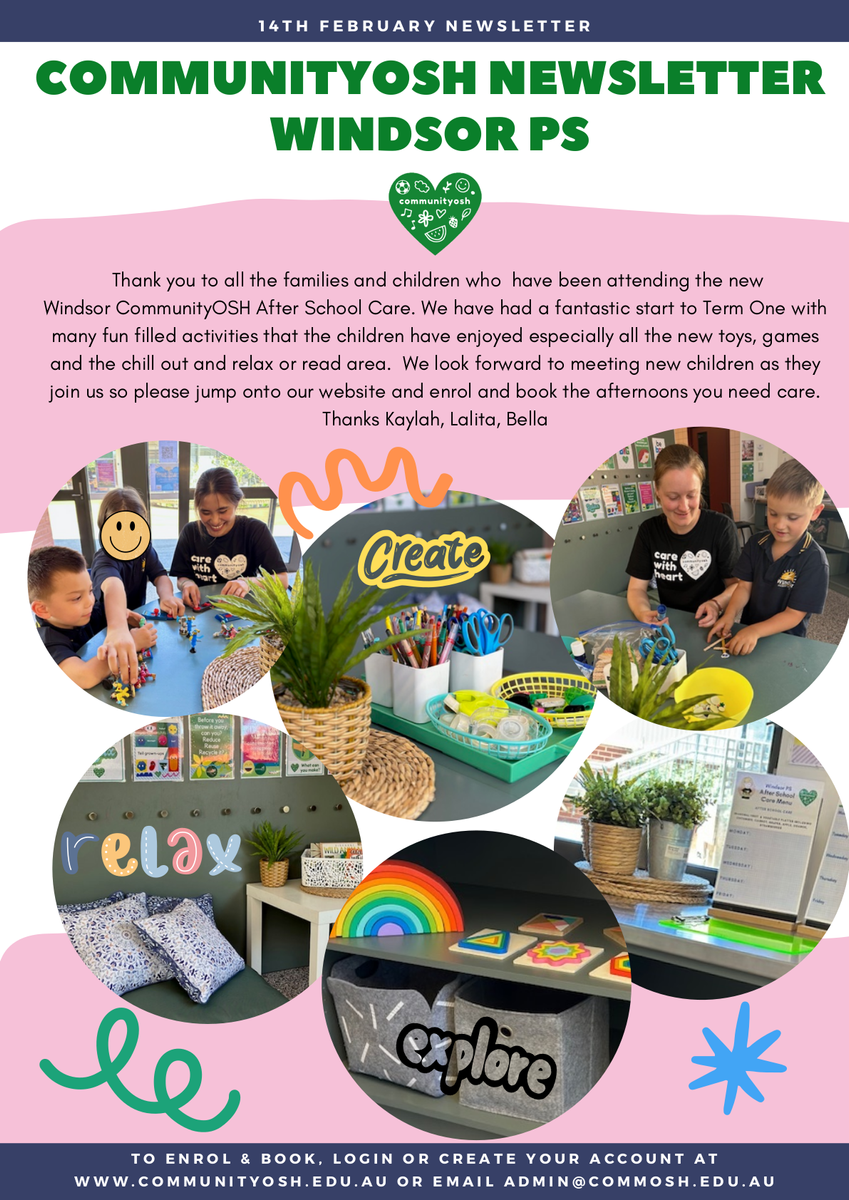
Our After School provider is Community OSH, which runs from 3:30pm - 6:00pm.To book your child/ren visit www.commosh.edu.au
School Uniform
Please ensure that your child is dressed in correct school uniform before they leave the house in the morning.School uniform order forms need to be completed with payment and returned to the office either by your child or via e-mail at windsor.ps@education.vic.gov.au
School Uniform Order Form
Lunch Orders
Lunch orders are available on Mondays and Fridays.Please remember all orders must be placed online before 9:00am at beaverstail.com.au
Lunch Order Menu
COMMUNITY NEWS